<?xml version="1.0" encoding="utf-8"?><feed xmlns="http://www.w3.org/2005/Atom" ><generator uri="https://jekyllrb.com/" version="3.10.0">Jekyll</generator><link href="https://uasal.github.io/feed.xml" rel="self" type="application/atom+xml" /><link href="https://uasal.github.io/" rel="alternate" type="text/html" /><updated>2026-06-03T13:43:27+00:00</updated><id>https://uasal.github.io/feed.xml</id><title type="html">University of Arizona Space Astrophysics Lab</title><subtitle>We build hardware and code to find exoplanets at Steward Observatory</subtitle><author><name>UASAL</name></author><entry><title type="html">Blog_post_jaegun_kai_phung</title><link href="https://uasal.github.io/Blog_Post_Jaegun_Kai_Phung/" rel="alternate" type="text/html" title="Blog_post_jaegun_kai_phung" /><published>2026-04-09T00:00:00+00:00</published><updated>2026-04-09T00:00:00+00:00</updated><id>https://uasal.github.io/Blog_Post_Jaegun_Kai_Phung</id><content type="html" xml:base="https://uasal.github.io/Blog_Post_Jaegun_Kai_Phung/"><![CDATA[<h1 id="a-new-window-to-the-stars-why-jaegun-yoo-wants-you-to-look-up">A New Window to the Stars: Why Jaegun Yoo Wants You to “Look Up”:</h1>

<p><em>Kai Phung</em></p>

<p><em>University of Arizona</em></p>

<p><img src="/assets/blog_images/2026-04-09-Blog_Post_Jaegun_Kai_Phung_Room.jpg" alt="6 inch and 7 inch diameter Integrating Spheres" width="800" /></p>

<p>Sometimes the path to the stars begins on the living room floor.
For Jaegun Yoo, the journey to becoming a space scientist started not with a telescope, but with a screwdriver and a pile of broken toys.
As a child, he didn’t just play with his things; he took them apart to see how they worked—
a curiosity that eventually led him into a career in mechanical engineering.
Now, his path has brought him back to his childhood wonder, but on a much grander scale. 
At the University of Arizona’s Steward Observatory, Jaegun is the “master of temperature” for the UASAL team.
Using the same persistence he developed while trying to beat the “final boss” in video games,
he is now tackling the ultimate challenge: ensuring a multimillion-dollar telescope can survive the brutal, unforgiving temperatures of deep space.</p>

<hr />

<p><strong>1. What is  your role on UASAL and why is it important to the team?</strong></p>

<p>My role at the University of Arizona Space Astrophysics Lab (UASAL) is to design the temperature control system that keeps the space telescope and its instruments within the right operating temperature range in space. Space is really different from what we’re used to on Earth, and there is no air and no convection, so heat doesn’t move around the same way. Also, space is an extreme environment. Deep space is close to -459.67 °F (almost as cold as you can get), but surfaces facing the sun can heat up to around 300°F, depending on the space telescope’s design and orbit. Different instruments on the telescope require different operating temperatures, and they are all connected. Hence, heating or cooling one part can affect another.</p>

<p>To make sure an astronomical space instrument works safely and performs well, we do three main steps. First, we run on-orbit simulations to predict how hot or cold the space telescope will get in orbit. Next, based on those results, we design and build thermal control hardware – things like heaters, insulation, and radiators. Finally, we test and validate the system in a thermal vacuum chamber, which recreates (replicates) space conditions to verify that our design works.</p>

<p>This role is important because if the telescope gets too hot or too cold, the instruments can stop working or the image quality can degrade. In other words, my role helps instruments survive in space and produce good scientific data.</p>

<p><img src="/assets/blog_images/IMG_1106.jpg" alt="6 inch and 7 inch diameter Integrating Spheres" width="800" /></p>

<p><em>Jaegun Yoo in the UA Steward Observatory Cleanroom</em></p>

<p><strong>2. What previous experiences have prepared you for working at Steward Observatory on Space Missions?</strong></p>

<p>I believe there are three things that have prepared me for working on the UASAL team. First, my initial major was not astronomy and space science. I majored in Mechanical Engineering before I started studying Astronomy and Space Science. I worked in the mechanical and aerospace industries for many years, and I participated in small CubeSAT (miniature satellites) projects. I believe my previous experience has prepared me well for working on the UASAL team.</p>

<p>Second, when I was a kid I loved toys, but I didn’t just play with them. I often took them apart piece by piece because I was curious about how they were built and how they worked. Even though my parents sometimes had to buy new toys because of me, I think that curiosity is still with me today. It helps a lot when I’m trying to understand a complex spacecraft system.</p>

<p>Third, I’ve always enjoyed video games. When I start a game, I usually keep going until I beat the final boss and see the ending. That habit trained me to be persistent to keep trying even when something is hard. In spacecraft development, problems aren’t always solved quickly, so that “stick with it” mindset is very useful, and it also helps me support my team when things get challenging.</p>

<p><strong>3. Why should everyone care about this project?</strong></p>

<p>As I mentioned earlier, space exploration takes a huge amount of time, people, and funding. This is one of the biggest and most complex projects humans can build. The technologies we develop for space don’t just stay in space.</p>

<p>It’s not just astronomers—everyone is benefiting from space development. Over time, many of the space technologies end up helping people here on Earth in everyday life. Some good examples are memory foam and scratch-resistant lenses. These came from space development! So, as low-cost astronomical space instrumentation is successfully launched and deployed, I believe many people outside this community could benefit as well. In addition, low-cost astronomical space instrumentation could help the public have more chances to experience and connect with space more easily.</p>

<p><strong>4. What is the big picture of space exploration?</strong></p>

<p>How much do we really know about the universe? A lot of astronomers say we’ve only figured out a tiny fraction—maybe not even 1%. I think we humans often trust only what we can see, and we forget what we can’t see. Every day, we receive sunlight that existed long before we were even born—and we get it for free. Earth’s magnetic field blocks a lot of harmful particles from reaching us. If the distance between the Earth and the Sun was a little closer or farther away, Earth might have turned into a Venus or Mars where humans couldn’t live the way we do.</p>

<p>And here we are, living our everyday lives: we laugh, we cry, we argue/fight with friends, we compete, and honestly, we work really hard just to get through each day. So sometimes, I want to encourage people—especially students—not to only focus on what’s right in front of them on the ground. Look up. Take a breath. Give yourself a moment to step back and reflect on who you are and what really matters. For me personally, when I look at the universe that God created, it helps me reflect on myself. It reminds me to stay humble—and to live with gratitude to God.</p>

<p><img src="/assets/blog_images/2026-04-09-Blog_Post_Jaegun_Kai_Phung_Optical.jpg" alt="6 inch and 7 inch diameter Integrating Spheres" width="800" /></p>]]></content><author><name>UASAL</name></author><summary type="html"><![CDATA[A New Window to the Stars: Why Jaegun Yoo Wants You to “Look Up”:]]></summary></entry><entry><title type="html">Asi294 Teardown</title><link href="https://uasal.github.io/asi294-teardown/" rel="alternate" type="text/html" title="Asi294 Teardown" /><published>2026-02-08T00:00:00+00:00</published><updated>2026-02-08T00:00:00+00:00</updated><id>https://uasal.github.io/asi294-teardown</id><content type="html" xml:base="https://uasal.github.io/asi294-teardown/"><![CDATA[<h1 id="teardown-zwo-asi-294-pro">Teardown: ZWO ASI 294 Pro</h1>

<p><strong>Subject:</strong> ZWO ASI 294 MC/MM Pro
<strong>Warning:</strong> <em>A grounding strap was worn at all times.</em></p>

<p>There is conflicting information about whether the ASI 294 is an IMX294 or IMX492 sensor. This teardown is an initial attempt to locate the part number on the chip.</p>

<p>A secondary purpose of this post is to see if LLM/GAI tools can be used to speed up documentation generation.</p>

<h2 id="2-shell-removal">2. Shell Removal</h2>

<p><img src="../assets/blog_images/2026-02-08-asi294-teardown-images/IMG_0567.jpeg" alt="Rear shell removed, fan exposed, top" />
<img src="../assets/blog_images/2026-02-08-asi294-teardown-images/IMG_0571.jpeg" alt="Rear shell removed, fan exposed, side" />
—</p>

<h2 id="3-main-pcb">3. Main PCB</h2>
<p>Board contains a FPGA and pads heat sink the FPGA to side of the main radiative heatsink</p>

<p><img src="../assets/blog_images/2026-02-08-asi294-teardown-images/IMG_0582.jpeg" alt="Main PCB Top Down" /></p>

<hr />

<h2 id="4-cooling-system">4. Cooling System</h2>

<p><img src="../assets/blog_images/2026-02-08-asi294-teardown-images/IMG_0587.jpeg" alt="Heatsink and TEC unit" /></p>

<hr />

<h2 id="5-sensor">5. Sensor</h2>
<p>Close inspection does not reveal any identifying marks on the sensor. I expect it is under the chip and we will have to desolder.
<img src="../assets/blog_images/2026-02-08-asi294-teardown-images/IMG_0589.jpeg" alt="Sensor exposed from the top" />
<img src="../assets/blog_images/2026-02-08-asi294-teardown-images/IMG_0585.jpeg" alt="Open chamber, sensor face exposed" /></p>

<h3 id="back-side-of-sensor-board">Back side of sensor board</h3>

<p><img src="../assets/blog_images/2026-02-08-asi294-teardown-images/IMG_0658.jpg" alt="" /></p>

<p>Under the microscope and contrast enhanced it appears this is an IMX492LLJ
<img src="../assets/blog_images/2026-02-08-asi294-teardown-images/IMG_0665.jpg" alt="alt text" /></p>

<hr />

<p>LLM disclosure: <a href="https://uarizona.service-now.com/sp?id=kb_article_view&amp;sysparm_article=KB0012513">Google Gemini Licensed to University of Arizona</a> was used to generate a template of this blog post.</p>

<p>The prompts used were:</p>

<blockquote>
  <p>“please draft a markdown file that is a blog post of tearing down an astronomical camera CMOS camera (ASI 294 Pro) with photos, i will fill in the photo filenames and any technical details “</p>
</blockquote>

<p>This was run on fast and returned a wall of text that was not in markdown, not useful.</p>

<p>I switched the mode to “Pro” and re-ran the prompt. This generated a wordy document that was in markdown format and useable but still had too many descriptive adjectives and assumed i wanted to describe the technical datasheets of each part.
additional prompts:</p>

<blockquote>
  <p>“make it terser”
“remove adjectives and quantitative statements”</p>
</blockquote>

<p>I took this draft and filled in the images and rewording text to match reality.</p>

<p>final prompt:</p>
<blockquote>
  <p>here is my draft, please check for typos</p>
</blockquote>

<p>this was useful, Gemini noted paths that some of the paths were relative and some were fixed because of how i pasted into VS Code and a grammatical error (worn vs warn).</p>

<p>to figure out how long it took I asked Gemini for the timeline of those prompts and was met with the interesting response “I do not have access to the specific timestamps of when you entered your previous prompts in this session. I can only see the conversation history as a continuous flow of text.”</p>

<p>Based on my local file system timestamps the process of generating the document and conversing with Gemini took about 21 minutes.</p>]]></content><author><name>UASAL</name></author><summary type="html"><![CDATA[Teardown: ZWO ASI 294 Pro]]></summary></entry><entry><title type="html">AAS247 Conference Wrap up</title><link href="https://uasal.github.io/conferences/AAS247/" rel="alternate" type="text/html" title="AAS247 Conference Wrap up" /><published>2026-01-09T00:00:00+00:00</published><updated>2026-01-09T00:00:00+00:00</updated><id>https://uasal.github.io/conferences/AAS247</id><content type="html" xml:base="https://uasal.github.io/conferences/AAS247/"><![CDATA[<p>This year the American Astronomical Society Winter Meeting was in Phoenix and several of us made the short drive from Tucson to share some exciting research we’ve worked on for the past year or so.</p>

<h2 id="space-coronagraph-optical-bench-poster"><a href="https://aas247-aas.ipostersessions.com/default.aspx?s=39-69-CB-A3-2F-AB-A5-22-7D-C5-D3-5A-3E-78-CB-E6&amp;guestview=true">Space Coronagraph Optical Bench Poster</a></h2>

<p>** Ewan S. Douglas and team**
iPoster: <a href="https://aas247-aas.ipostersessions.com/default.aspx?s=39-69-CB-A3-2F-AB-A5-22-7D-C5-D3-5A-3E-78-CB-E6&amp;guestview=true">iPoster link</a></p>

<p>Expand details for presentation abstract</p>
<details>
Imaging sub-Neptune radius planets around Sunlike stars requires reaching ultra-high flux ration sensitivity, of order parts in a billion. To reach these contrasts internally on a space telescope requires a well optimized coronagraph with sub-nanometer wavefront sensing and control. There are significant gaps in realizing this technology for realistic observing scenarios with unstable telescopes in stellar flux limited regimes. At the University of Arizona we have built a vacuum space coronagraphy testbed, the Space COronagraph Optical Bench (SCoOB) to evaluate high-contrast imaging approaches. The baseline configuration includes a 952 actuator microelectromechanical deformable mirror and a liquid crystal polymer charge-6 vector vortex mask and reaches broadband normalized intensity contrasts lower than 1e-8 in air and in vacuum. SCoOB uses the software based on the Magellan Adaptive Optics-Extreme MagAO-X library, INDI and the realtime adaptive optics (AO) control library Compute and Control for Adaptive Optics (CACAO). This framework allows multichannel control and injection of realistic disturbances to test AO control loops. In addition to serving as a training ground for the next generation of high-contrast imaging students, work is underway to add UV coronagraphy, low-order wavefront control, and fully remote operations and a new refactored software library, eXtreme Wavefront Control Toolkit (XWCT). We will provide an overview of the SCoOB systems engineering and simulation approach, impact on open source software, and students trained.
</details>

<h2 id="lazuli-splinter-session-coronagaphy-slides"><a href="https://arizona.box.com/s/y56pi6ne9uvwwfjgu28pxiomu8jqqtgv">Lazuli Splinter Session Coronagaphy Slides</a></h2>

<p>** Ewan S Douglas and team**</p>

<p>slides: <a href="https://arizona.box.com/s/y56pi6ne9uvwwfjgu28pxiomu8jqqtgv">https://arizona.box.com/s/y56pi6ne9uvwwfjgu28pxiomu8jqqtgv</a></p>

<p>This presentation was part of a Schmidt Observatories Splinter Session which overall received a lot of media attention including <a href="https://www.astronomy.com/science/eric-and-wendy-schmidt-to-fund-space-telescope-three-ground-based-observatories/">Astronomy Magazine</a>,
<a href="https://arstechnica.com/space/2026/01/eric-schmidt-will-massively-invest-in-private-telescopes-including-hubble-replacement/">Ars Technica</a>, <a href="https://www.space.com/space-exploration/former-ceo-of-google-spearheads-4-next-gen-telescopes-3-on-earth-and-1-in-space">Space.com</a>, <a href="https://www.nytimes.com/2026/01/09/science/eric-schmidt-telescopes-google-space.html">NYTimes</a>.</p>

<p>Expand details for presentation abstract</p>
<details>
Spatially resolving and directly characterizing cold planets and disks in reflected light will unlock many new physical regimes, revealing unexplored architectures and histories of nearby stellar systems like our own.  For exoplanets, reflections are 10 million to beyond 10 billion times dimmer than their host star, and circumstellar debris disks span an even larger dynamic range. The Nancy Grace Roman Space Telescope Coronagraph is expected to take our first image of a Jupiter-analog. Beyond that, the Astro2020 decadal survey recommended a UV-optical-IR exoplanet imaging mission, now known as the Habitable Worlds Observatory (HWO) to characterize many Earthlike planets with a $\sim$6.5m space telescope

A flexibly scheduled, high-throughput 3m class coronagraphic imaging mission at 1e-8 or better flux ratio fills an important need. Such an observatory provides sensitivity to debris disks and giant exoplanets in the habitable zones of nearby stars, some of which could be followed up spectroscopically by Roman or HWO for detailed characterization. 

We have developed a two-arm coronagraph design that spans 400 to 750 nm, combines deformable mirrors, CMOS sensors, and vector vortex waveplates with Linux software derived from the MagAO-X instrument running on onboard GPUs. Testing has demonstrated whitelight &lt;1e-8 contrasts with existing hardware.

Combining such a coronagraph with an unobstructed 3 meter class telescope opens significant discovery potential for both exoplanet imaging and debris disks while demonstrating several new technologies.  Such a mission has the potential to rapidly expand our knowledge of solar systems like our own by minimizing hardware development to field a well-optimized, low-cost instrument this decade. We hope this process will scientifically and technologically accelerate the search for life with future HWO scale missions. We will describe the architecture, testing, simulation, and science impact of the proposed high-contrast imaging concept.

</details>

<p>Other presentations included.</p>]]></content><author><name>[&quot;Ewan Douglas et al.&quot;]</name></author><category term="conferences" /><category term="conferences" /><category term="papers" /><category term="blog" /><summary type="html"><![CDATA[This year the American Astronomical Society Winter Meeting was in Phoenix and several of us made the short drive from Tucson to share some exciting research we’ve worked on for the past year or so.]]></summary></entry><entry><title type="html">SPIE O+P 2025 Conference Proceedings Wrap up</title><link href="https://uasal.github.io/conferences/SPIE2025/" rel="alternate" type="text/html" title="SPIE O+P 2025 Conference Proceedings Wrap up" /><published>2025-08-20T00:00:00+00:00</published><updated>2025-08-20T00:00:00+00:00</updated><id>https://uasal.github.io/conferences/SPIE2025</id><content type="html" xml:base="https://uasal.github.io/conferences/SPIE2025/"><![CDATA[<h2 id="the-space-coronagraph-optical-bench-scoob-6-demonstration-of-lyot-low-order-wavefront-control-combined-with-high-order-wavefront-control-using-a-vortex-coronagraph"><a href="arxiv.org/abs/2509.02875">The Space Coronagraph Optical Bench (SCoOB): 6. demonstration of Lyot low order wavefront control combined with high order wavefront control using a vortex coronagraph</a></h2>
<p><strong>Kian Milani</strong>, Kyle Van Gorkom, Chris B. Mendillo, Ramya Anche, Jaren N. Ashcraft, Kevin Derby, Jared Males, Adam Schilperoort, Ewan S. Douglas</p>
<details>
To reach and maintain high contrast levels, coronagraph instruments will require a combination of low-order and high-order wavefront control techniques to correct for dynamic wavefront error. Efficient low-order wavefront sensing and control (LOWFSC) schemes use the starlight rejected by the coronagraph such that LOWFSC can operate with a relatively bright signal to correct rapid disturbances. Meanwhile, a family of high-order wavefront sensing and control (HOWFSC) techniques utilizing the science camera have been developed to create regions of high contrast known as dark holes. These two control loops must operate simultaneously for dark holes to be maintained over long observation periods. Using a 952 actuator MEMS deformable mirror and a vector vortex coronagraph (VVC) on the Space Coronagraph Optical Bench (SCoOB), we demonstrate a Lyot-based LOWFSC loop operating in combination with a HOWFSC loop. For these experiments, implicit electric field conjugation (iEFC) is the chosen HOWFSC technique, and we demonstrate how this empirical method can be calibrated and deployed while the LOWFSC loop corrects for dynamic wavefront error. We show this combination of LOWFSC and iEFC maintained 1E-8 contrast levels in air. https://arxiv.org/abs/2509.02875
</details>

<h2 id="the-space-coronagraph-optical-bench-scoob-7-design-fabrication-and-first-light-for-a-self-coherent-camera"><a href="https://arxiv.org/abs/2509.02877">The Space Coronagraph Optical Bench (SCoOB): 7. design, fabrication, and first light for a self-coherent camera</a></h2>
<details>
The 2020 Decadal Survey on Astronomy and Astrophysics tasked future space observatories with the goal of detecting and characterizing a large sample of Earth-like exoplanets. To achieve this, these observatories will require coronagraphs and wavefront control algorithms in order to achieve 10−10 or better starlight suppression. The Space Coronagraph Optical Bench (SCoOB) is a vacuum compatible testbed at the University of Arizona which aims to advance and mature starlight suppression technologies in a space-like environment. In its current configuration, SCoOB is a charge-6 vector vortex coronagraph outfitted with a Kilo-C microelectromechanical systems deformable mirror capable of achieving sub-10−8 dark hole contrast at visible wavelengths using implicit electric field conjugation (iEFC). In this work, we demonstrate the use of a self-coherent camera (SCC) for dark hole digging and maintenance on SCoOB. The SCC introduces a small off-axis pinhole in the Lyot plane which allows some starlight to reach the focal plane and interfere with residual speckles. This enables high-order focal-plane wavefront sensing which can be combined with active wavefront control to null the speckles in a specified region of high contrast known as the dark hole. We discuss considerations for implementation, potential limitations, and provide a performance comparison with iEFC. We also discuss the design optimization and fabrication process for our SCC Lyot stops. 
https://arxiv.org/abs/2509.02877
</details>

<h2 id="the-space-coronagraph-optical-bench-scoob-8-end-to-end-numerical-modeling-of-the-testbed-to-estimate-the-contrast-limits"><a href="https://arxiv.org/abs/2509.02887">The Space Coronagraph Optical Bench (SCoOB): 8. end-to-end numerical modeling of the testbed to estimate the contrast limits</a></h2>
<p><strong>Ramya M Anche</strong>, Kyle Van Gorkom, Kian Milani, Kevin Derby, Emory Jenkins, Jaren Ashcraft, Saraswathi Kalyani Subramanian, Patrick Ingraham, Daewook Kim, Heejoo Choi, Olivier Durney, Ewan Douglas</p>
<details>
The space coronagraph optical bench (SCoOB) at the University of Arizona is a high-contrast imaging testbed designed to operate in a vacuum to obtain a contrast better than 1e-8 in optical wavelengths using vector vortex coronagraph (VVC) masks. The testbed performance in a half-sided D-shaped dark hole is 2.2e-9 in a &lt;&lt; 1% BW, 4e-9 in a 2% BW, and 2.5e-8 in a 15% BW. While the testbed has met the design specification contrast requirements in monochromatic wavelengths, comprehensive end-to-end numerical modeling to assess contrast limits across different bandpasses has yet to be conducted. In this work, we discuss the results of numerical modeling for the SCoOB testbed in both monochromatic and 10% bandwidths at 525 nm and 630 nm. This modeling incorporates measured VVC retardance, modeled polarization aberrations, measured surface and reflectivity errors, and diffuse and surface reflectivity. We explore and discuss the various factors contributing to the contrast limits. https://arxiv.org/abs/2509.02887
</details>

<h2 id="stages-of-commissioning-alignment-for-three-mirror-anastigmat-tma-telescopes">Stages of commissioning alignment for three-mirror anastigmat (TMA) telescopes</h2>
<p><strong>Solvay Blomquist</strong>, Heejoo Choi, Hyukmo Kang, Hayden Kim, Kevin Derby, Pierre
Nicolas, Joanna Rosenbluth, Patrick Ingraham, Ewan S. Douglas, and Daewook Kim</p>
<details>
For this study, we present a method for performing an autonomous alignment of a three-mirror anastigmat (TMA) telescope on orbit. The motivation for this study comes from the want to explore options to align the TMA on orbit post-deployment while keeping relative cost to science ratio low. The detector used in the TMA under study provides us with a large field of view (FOV). With a large FOV provided in the design, we can use many stars as sample points to drive this alignment knowing how the average size of the star across the detector changes as a function of moving the secondary mirror (M2). Adjustment of the secondary mirror will happen in a multi-stage procedure, starting with a coarse alignment with a large range of motion, and ending with a finer alignment driven by small, random perturbations of M2. For testing this algorithm, we generate a set of possible misalignment cases of the telescope and test how the multi-stage procedure aligns the telescope from a highly misaligned state to a point at which finer alignment can take over to begin science observations. 
</details>

<h2 id="stray-and-scattered-light-considerations-in-a-non-contiguous-array-of-commercial-cmos-sensors-in-a-space-mission">Stray and Scattered Light Considerations in a Non-contiguous Array of Commercial CMOS Sensors in a Space Mission</h2>
<p><strong>Maggie Y. Kautz</strong>, Douglas Kelly, Heejoo Choi, Young Sik Kim, Fernando Coronado, Cameron C. Ard, Patrick Ingraham, Daewook Kim, Ewan S. Douglas</p>
<details>
Recent advances in CMOS technology have potential to significantly increase the performance, at low-cost, of an astronomical space telescope. Arrays of sensors in space missions are typically contiguous and act as a monolithic detector. A non-contiguous array, with gaps between individual commercial CMOS detectors, offers potential cost and schedule benefits but poses a unique challenge for stray/scattered light mitigation due to complexities in the optomechanics. For example, if the array of detectors is being fed a large field of view, then each detector will have a different angle of incidence. Any individual bandpass filters need to be held perpendicular to the incoming beam so as not to create variances of central wavelength transmission from detector to detector. It naturally follows that the optical design can force filter ghosts to fall between detectors. When dealing with well-focused, high-intensity beams, first and second order stray light path analyses must be conducted to determine scattered light from glints off of individual optics/opto-mechanics or detector specific vane structures. More mechanical structures are necessary for imaging with non-contiguous arrays, all of which have potential to increase scattered light. This proceeding will document various stray light mitigation strategies for a non-contiguous array of sensors in a space telescope.
</details>

<h2 id="progress-toward-a-demonstration-of-high-contrast-imaging-at-ultraviolet-wavelengths">Progress toward a demonstration of high contrast imaging at ultraviolet wavelengths</h2>
<p><strong>Kyle Van Gorkom</strong>, Ramya M. Anche, Christopher B. Mendillo, Jessica Gersh-Range, G.C. Hathaway, Saraswathi Kalyani Subramanian, Justin Hom, Tyler D. Robinson, Mamadou N’Diaye, Nikole K. Lewis, Bruce Macintosh, and Ewan S. Douglas</p>
<details>
NASA's Habitable Worlds Observatory (HWO) aims to achieve starlight suppression to the $10^{-10}$ level for the detection and spectral characterization of Earth-like exoplanets. Broadband ozone absorption features are key biosignatures that appear in the 200-400nm near-ultraviolet (UV) regime. Extending coronagraphy from visible wavelengths to the UV, however, brings with it a number of challenges, including tighter requirements on wavefront sensing and control, optical surface quality, scattered light, and polarization aberrations, among other things. We aim to partially quantify and address these challenges with a combination of modeling, high-resolution metrology to the scales required for UV coronagraphy, and—ultimately—a demonstration of UV coronagraphy on the Space Coronagraph Optical Bench (SCoOB) vacuum testbed. In these proceedings, we provide a status update on our modeling and contrast budgeting efforts, characterization efforts to understand performance limitations set by key optical components, and our plans to move toward a demonstration of UV coronagraphy.
</details>

<h2 id="polarization-aberration-modeling-of-internal-occulters-for-coronagraphs"><a href="https://arxiv.org/abs/2508.19397">Polarization aberration modeling of internal occulters for coronagraphs</a></h2>
<p><strong>Emory L. Jenkins</strong>, A J Eldorado Riggs, Ewan S. Douglas, Ramya M. Anche, Dylan M.
McKeithen, and Stuart B. Shaklan</p>
<details>
The Habitable Worlds Observatory (HWO) coronagraph instrument will need to block starlight so effectively that only one in every $10^{10}$ photons reaching the telescope makes it to the science camera. Otherwise, light from a planet orbiting the star will be buried below the level of the starlight. This is about 100 times the performance of the current generation of space coronagraphs, requiring a significant advancement in starlight rejection. At such extreme contrasts, every optical component must be analyzed for leakage due to imperfections in manufacturing or even the underlying physics that can cause unwanted starlight to reach the science camera. For components with small features, the interaction of the electric and magnetic fields with interfaces of different materials can lead to starlight leakage that may limit performance. This paper considers the Lyot occulter, a small metal dot used by the Lyot family of coronagraph instruments to block the image of a star from reaching the science camera. We use a numerical simulation of Maxwell's equations to estimate the impact of various Lyot occulter geometries on starlight leakage. With these results, we find that starlight leakage from Lyot occulting masks is a non-negligible but mitigatable source of leakage at the required level of performance for the HWO. https://arxiv.org/abs/2508.19397
</details>

<h2 id="end-to-end-polarization-aberrations-simulation-for-the-decadal-survey-testbed-dst-2">[End-to-end polarization aberrations simulation for the Decadal Survey Testbed (DST-2)]</h2>
<p><strong>Ramya Anche</strong> et al.</p>
<details>
</details>

<h2 id="design-and-assembly-of-the-telescope-simulator-for-continuous-wavefront-sensing-and-control">Design and assembly of the telescope simulator for continuous wavefront sensing and control</h2>
<p><strong>Hyukmo Kang</strong> et al</p>
<details>
</details>

<h2 id="stray-light-suppression-for-a-large-etendue-monolithic-space-telescope">Stray light suppression for a large etendue monolithic space telescope</h2>
<p><strong>Heejoo Choi</strong> et al</p>
<details>
</details>

<h2 id="fine-alignment-and-wavefront-maintenance-of-a-three-mirror-anastigmat-using-full-field-phase-retrieval-with-algorithmic-differentiation">Fine alignment and wavefront maintenance of a three-mirror anastigmat using full-field phase retrieval with algorithmic differentiation</h2>
<p><strong>Kevin Z. Derby</strong> et al.</p>
<details>
</details>

<h2 id="wave-simulation-for-diffraction-efficiency-of-an-integral-field-spectrograph">Wave simulation for diffraction efficiency of an integral field spectrograph</h2>
<p><strong>Pierre Nicholas</strong> et al.</p>
<details>
</details>

<h2 id="methods-for-determining-the-blackbody-radiation-and-photon-rate-for-an-infrared-telescopes">Methods for determining the blackbody radiation and photon rate for an infrared telescopes</h2>
<p><strong>Brian Catanzaro</strong> et al.</p>
<details>
</details>

<h2 id="characterization-of-optomechanical-joints-through-lap-shear-testing">Characterization of optomechanical joints through lap shear testing</h2>
<p><strong>Austin Mears</strong> et al.</p>
<details>
</details>]]></content><author><name>[&quot;Ewan Douglas et al.&quot;]</name></author><category term="conferences" /><category term="conferences" /><category term="papers" /><category term="blog" /><summary type="html"><![CDATA[The Space Coronagraph Optical Bench (SCoOB): 6. demonstration of Lyot low order wavefront control combined with high order wavefront control using a vortex coronagraph Kian Milani, Kyle Van Gorkom, Chris B. Mendillo, Ramya Anche, Jaren N. Ashcraft, Kevin Derby, Jared Males, Adam Schilperoort, Ewan S. Douglas To reach and maintain high contrast levels, coronagraph instruments will require a combination of low-order and high-order wavefront control techniques to correct for dynamic wavefront error. Efficient low-order wavefront sensing and control (LOWFSC) schemes use the starlight rejected by the coronagraph such that LOWFSC can operate with a relatively bright signal to correct rapid disturbances. Meanwhile, a family of high-order wavefront sensing and control (HOWFSC) techniques utilizing the science camera have been developed to create regions of high contrast known as dark holes. These two control loops must operate simultaneously for dark holes to be maintained over long observation periods. Using a 952 actuator MEMS deformable mirror and a vector vortex coronagraph (VVC) on the Space Coronagraph Optical Bench (SCoOB), we demonstrate a Lyot-based LOWFSC loop operating in combination with a HOWFSC loop. For these experiments, implicit electric field conjugation (iEFC) is the chosen HOWFSC technique, and we demonstrate how this empirical method can be calibrated and deployed while the LOWFSC loop corrects for dynamic wavefront error. We show this combination of LOWFSC and iEFC maintained 1E-8 contrast levels in air. https://arxiv.org/abs/2509.02875 The Space Coronagraph Optical Bench (SCoOB): 7. design, fabrication, and first light for a self-coherent camera The 2020 Decadal Survey on Astronomy and Astrophysics tasked future space observatories with the goal of detecting and characterizing a large sample of Earth-like exoplanets. To achieve this, these observatories will require coronagraphs and wavefront control algorithms in order to achieve 10−10 or better starlight suppression. The Space Coronagraph Optical Bench (SCoOB) is a vacuum compatible testbed at the University of Arizona which aims to advance and mature starlight suppression technologies in a space-like environment. In its current configuration, SCoOB is a charge-6 vector vortex coronagraph outfitted with a Kilo-C microelectromechanical systems deformable mirror capable of achieving sub-10−8 dark hole contrast at visible wavelengths using implicit electric field conjugation (iEFC). In this work, we demonstrate the use of a self-coherent camera (SCC) for dark hole digging and maintenance on SCoOB. The SCC introduces a small off-axis pinhole in the Lyot plane which allows some starlight to reach the focal plane and interfere with residual speckles. This enables high-order focal-plane wavefront sensing which can be combined with active wavefront control to null the speckles in a specified region of high contrast known as the dark hole. We discuss considerations for implementation, potential limitations, and provide a performance comparison with iEFC. We also discuss the design optimization and fabrication process for our SCC Lyot stops. https://arxiv.org/abs/2509.02877]]></summary></entry><entry><title type="html">AO Summer School 2025</title><link href="https://uasal.github.io/students/team/AO_Summer_School2025/" rel="alternate" type="text/html" title="AO Summer School 2025" /><published>2025-08-19T00:00:00+00:00</published><updated>2025-08-19T00:00:00+00:00</updated><id>https://uasal.github.io/students/team/AO_Summer_School2025</id><content type="html" xml:base="https://uasal.github.io/students/team/AO_Summer_School2025/"><![CDATA[<h1 id="ao-summer-school-2025">AO Summer School 2025</h1>
<p><em>Editor’s Note: Marcus’ post below describes this year’s <a href="https://cfao.science.ucsc.edu/ao-summer-school/">CfAO Summer School</a> at UCSC. for more banana slug content see our sibling CAAO <a href="https://xwcl.science/magao-x/ao-summer-school-part-iii-the-return-of-the-higher-orders/">MagAO-X lab’s blog posts</a>.</em></p>

<h2 id="day-1-travel-to-ucsc">Day 1 (Travel to UCSC)</h2>
<p>I woke up early on Sunday morning as excitement about the coming week kept me from my slumber. Katie, Josh, Parker, and I stopped for some breakfast at the Tucson airport and waited for boarding to start. As we waited, I quickly realized that I was a second class citizen in the eyes of delta airlines. Josh, the most experienced traveler with numerous trips to Chile, enjoyed a upgrade to first class while I suffered in the last row with a chair that would not recline.</p>

<p><img src="/assets/AO_Summer_School_Photos_2025/josh_first_class.jpeg" alt="Josh in first class" width="500" /></p>

<p><em>Josh enjoying first class</em></p>

<p>After a quick flight we landed in LAX to catch another connecting flight to the tech hub of America and the “Heart of Silicon Valley”, the San Jose airport. In the San Jose airport we enjoyed multiple ad campaigns about AI and how it will improve my work (Will AI push to main?). From here we needed to catch a quick 45 minute uber from the airport to the UCSC campus. However, once we started driving we ran into immense traffic due to a car accident (Why does San Jose only have one road and so many people?). Our uber driver, who spoke no English, bobbed and weaved through traffic trying to get us to campus in a timely manner. But alas to no avail we had to tough out the traffic. A 45 minute uber slowly and with much agony turned into a 2+ hour trip. He pulled out google translate and told us that he was sorry for the inconvenience but hinted that he had an idea to pass the time. He whipped out his iPad with lighting speed and placed it on the dash. With a slight chuckle and twinkle in his eye he played “Happy Gilmore 2” in English with Spanish subtitles and English narration (which is arguably the only way to watch this movie). Time flew by and eventually we made it the UCSC campus where we then checked into out dorm rooms.</p>

<p>After checking into our rooms, we met some friends from the Gemini Observatory and the University of Victoria. We decided to travel down to Santa Cruz and explore the city.</p>

<p><img src="/assets/AO_Summer_School_Photos_2025/hammock_bar.PNG" alt="Hammock elixer shop" width="800" /></p>

<p><em>We stopped at a elixir tea shop in downtown Santa Cruz</em></p>

<h2 id="day-2-day-1-of-summer-school">Day 2 (Day 1 of Summer School)</h2>

<p>Day 2 started off early with breakfast at the college 9 and 10 dining halls (The food was exactly as you would expect and gave me flash backs to my freshman year). The summer school then began promptly at 9am where we enjoyed great talks from Becky Jenson-Clem (Introduction to AO for astronomy), Becky and Phil Hinz (AO the game), Renate Kupke (Introduction to Ray Optics), Nicole Putnam (Introduction to AO for vision science). In these talks we learned valuable information that would prove vital for the hands on labs that would take place in the coming days. In addition to these talks, students presented their work in a poster session.</p>

<p>Day 2 ended with a reception at the CfAO Atrium where we got our eye balls measured…</p>

<h2 id="day-3">Day 3</h2>

<p>Day 3 started off in a similar fashion to day 2, however, I was more excited to get down and dirty with the concepts of wavefront sensing and reconstruction. We learned the theory behind the Shack-Hartman WFS and the Pyramid WFS in addition to some others. We next transition from presentations to hands on labs, where we go to build and play with our own AO kit.</p>

<p><img src="/assets/AO_Summer_School_Photos_2025/ao_kit.png" alt="ao_kit" width="800" /></p>

<h2 id="day-4">Day 4</h2>

<p>Day 4 continues with presentation and labs. For the presentation portion we learned about atmospheric turbulence (Saavidra Perera), deformable mirrors (Phil Hinz), and Laser Guide Stars (Jessica Lu). My favorite presentation was the one from Phil where we learned about the interaction matrix, which mathematically connects the WFS to the actuators on the deformable mirror (I’m a sucker for anything remotely related to controls). In the lab portion of Day 4 we got to build / align our own WFS. We placed a Shack-Hartman WFS in our “telescope” and were able to see the grid of dots through our camera. We then used the same Shack-Hartman WFS but moved it to a focal plane to create a makeshift pyramid WFS. Surprisingly it worked very well.</p>

<p><img src="/assets/AO_Summer_School_Photos_2025/wfs_lab.png" alt="wfs lab" width="800" /></p>

<p><em>Katie geeking on how well its working</em></p>

<p>We also got a tour of the SEAL and UCO shops.</p>

<p><img src="/assets/AO_Summer_School_Photos_2025/vibration_table.jpeg" alt="vibration table" width="800" /></p>

<p><em>Becky told me not to go under the solid granite vibration table if there was a earth quake…</em></p>

<h2 id="day-5">Day 5</h2>

<p>Day 5 marched on with presentations from Nour Skaf (Control Theory), Bruce Macintosh (Error Budgets), and Emiel Por (AO Simulations). I enjoyed the control theory talk but quickly realized that the systems I am used to encountering in controls are inherently different than those used to describe AO control systems. The HCIpy tutorial given by Emiel was also intellectually stimulating.</p>

<p><img src="/assets/AO_Summer_School_Photos_2025/sleepy_time2.jpeg" alt="sleepy time2" width="800" /></p>

<p><em>Sleepy time immediately after Emiel’s talk.</em></p>

<h2 id="day-6-final-day">Day 6 (Final Day)</h2>

<p>Day 6 made headway, you guessed it, in the same way as the previous days. I was interested in the Astro photonics talk by Kevin Bundy. In this talk I learned about photonic logic gates which apparently can cause phase kicks (goodbye traditional DM, AHAH I JOKE). Finally, we enjoyed an amazing talk about AO in space which was presented by Rus Belikov. He presented a high level overview of how AO system in conjunction with coronagraphs work. He then dived a little deeper in to EFC and other speckle nulling methods. Overall, I enjoyed this talk since I now feel like I have enough basic knowledge to understand what other people in my lab have been talking about for the past two years….</p>

<p>Finally, we ended our AO summer school journey with awards … that were based on our eye ball measurements from earlier in the week. We have a few winners. First being Chia-Lin, who won smallest pupil!</p>

<p><img src="/assets/AO_Summer_School_Photos_2025/chialin_award.jpeg" alt="chialin_award" width="800" /></p>

<p><em>Just 3.4 mm, for reference mine was 6.7 mm</em></p>

<p>And some from our very own sister lab, MagAO-x! Josh won the worst optic award by measuring a strehl of just 1%. His award was title the Hubble Space Telescope Award <sub>(before the manned mission to fix the optic)</sub>. Parker won the Adaptive Optic award for the pupil with the largest diameter change between measurements. Unfortunately Katie and I did not win any awards, which initially made us sad but we quickly remembered that not winning an award means that our eyes are not broken.</p>

<p><img src="/assets/AO_Summer_School_Photos_2025/josh_award.png" alt="josh_award" width="800" /></p>

<p><img src="/assets/AO_Summer_School_Photos_2025/parker_award.png" alt="parker_award" width="800" /></p>

<h3 id="later-that-night">Later that night</h3>
<p>After a long week of fun learning and hands on experiments, a group of us decided to explore the city of Santa Cruz before we bid goodbye. We headed down to the boardwalk to watch Josh, Parker, and Andre jump into the pacific ocean. <em>(Will not post those pictures…)</em></p>

<p>Later, we hung out at the arcade and enjoyed some fun games.</p>

<p><img src="/assets/AO_Summer_School_Photos_2025/santa_cruz_boardwalk.PNG" alt="Boardwalk" width="800" /></p>

<p><em>Some fun attractions right on the beach front!</em></p>

<p><img src="/assets/AO_Summer_School_Photos_2025/arcade_dance.PNG" alt="arcade_dance" width="800" /></p>

<p><em>Josh and Parker up to their neck in dance dance revolution.</em></p>

<p>Finally, we hit the karaoke bar where, to my surprise, I enjoyed watching Josh and Katie lose their voices. <em>(Again, not pictured … <sub>but come to my office and I’ll show you</sub>. )</em></p>

<h2 id="all-in-all">All in All</h2>
<p>From the lessons learned, to the friendships formed, to the rock-hard dorm room mattress, AO Summer School was an unforgettable experience—one that a mere blog can’t fully capture. And with that, I bid farewell to AO Summer School, and to you, dear reader.</p>

<p>– Marcus Klupar</p>

<p>Quote of the Blog: “It is not where you start, but where you stand” - me</p>

<p>Song of the Blog: <a href="https://www.youtube.com/watch?v=QeyZA5Mhijk">This Town’s Been Too Good To Us (Santa Cruz)</a></p>

<h2 id="bonus-photos">Bonus Photos</h2>

<p>banana … banANNNNA… BAAAANNNNAAAANNNNAA SLUG!
<img src="/assets/AO_Summer_School_Photos_2025/banana_slug.PNG" alt="slug" width="800" /></p>

<p>Turkey on campus.</p>

<p><img src="/assets/AO_Summer_School_Photos_2025/turkey.jpeg" alt="turkey" width="800" /></p>

<p>Fun pin that resonated with me.</p>

<p><img src="/assets/AO_Summer_School_Photos_2025/100_slug.jpeg" alt="100% slug" width="800" /></p>]]></content><author><name>[&quot;Marcus Klupar&quot;]</name></author><category term="students" /><category term="team" /><category term="graduate students" /><category term="blog" /><summary type="html"><![CDATA[AO Summer School 2025 Editor’s Note: Marcus’ post below describes this year’s CfAO Summer School at UCSC. for more banana slug content see our sibling CAAO MagAO-X lab’s blog posts.]]></summary></entry><entry><title type="html">Integrating Sphere Build Process</title><link href="https://uasal.github.io/design/Integrating-Sphere-build-process/" rel="alternate" type="text/html" title="Integrating Sphere Build Process" /><published>2025-02-15T00:00:00+00:00</published><updated>2025-02-15T00:00:00+00:00</updated><id>https://uasal.github.io/design/Integrating-Sphere-build-process</id><content type="html" xml:base="https://uasal.github.io/design/Integrating-Sphere-build-process/"><![CDATA[<p>Author: Nikoli Cooper, UA undergraduate TIMESTEP Apprentice.</p>

<p>Commercial Integrating Spheres on the market are high quality, yet expensive. A 6” diameter can cost upwards of $2000. In order to minimize the cost of CMOS characterization, we have devised a procedure to create our own small Integrating Sphere (up to 7” diameter) from scratch.<br />
<strong>This characterization is distinct from sensor characterization performed at the <a href="https://itl.arizona.edu/">UA Imaging Technology Lab</a> discussed in other blog posts (e.g. https://uasal.github.io/testing/sensor_reports/)</strong>.</p>

<h2 id="design-process">Design Process</h2>

<p>We designed one 6” and one 7” diameter Integrating Sphere in SolidWorks with a few design criteria:</p>

<ul>
  <li><strong>Surface area covered by ports must be 5% max,</strong> from <a href="http://www.moria.de/tech/integrating-sphere/">Building an Integrating Sphere</a></li>
  <li><strong>Spheres must be 3D printable on a Prusa mk4. (7” max diameter, with flange)</strong></li>
  <li><strong>Outlet port must be able to cover the majority of a Sony IMX455 (1.7” diagonal), and the inlet port must be set up for an optical fiber.</strong></li>
  <li><strong>A baffle must block light from directly exiting from the inlet port.</strong>
<img src="/assets/blog_images/2025-02-15-Integrating-Sphere-build-process-Two_Spheres_with_Fiber.jpg" alt="6 inch and 7 inch diameter Integrating Spheres" width="800" /></li>
</ul>

<h2 id="fabrication">Fabrication</h2>

<ol>
  <li>The two Integrating Spheres were 3D printed on a <strong>Prusa mk4</strong> in PLA. They both have a <strong>2.5” diameter outlet port</strong>, and a <strong>1” diameter inlet port</strong> for use with <strong><a href="https://www.edmundoptics.com/p/1-sma-adapter-for-4-6-integrating-sphere/32111/">Edmund Optic’s 1” SMA adapter</a></strong> for optical fiber attachment. Each sphere was printed in two halves and connected via a flange with <strong>8 M6 bolts</strong>.</li>
  <li>Following printing, the Spheres were <strong>rigorously sanded with 60 and 80 grit sandpaper</strong> to remove imperfections and texture from the 3D printing process. Any small holes in the inside surface were coated with <strong>Elmer’s glue</strong> to prevent paint leakage.</li>
  <li><strong>2 coats of aluminum silver paint</strong> were applied first to make the spheres light-tight and to reflect light above <strong>900 nm</strong>, where the white wall’s reflectivity starts to drop off. <strong>Both spheres used a total of 30 ml of silver paint</strong>.</li>
  <li>6 coats of <strong><a href="https://www.edmundoptics.com/p/250ml-pre-mix-white-reflectance-coating/26992/">Avian B white wall with Barium Sulfate</a></strong> were used as the main high-reflectivity coating. Paint was applied in thin layers and diluted with water (around 50%) for airbrush application. <strong>Coating both spheres used around 1/2 - 2/3 of a 250 ml bottle of Avian B</strong>.</li>
</ol>

<h2 id="testing">Testing</h2>

<p>The main ways to evaluate an Integrating Sphere are by its <strong>sphere multiplier</strong> and its <strong>reflectance</strong>. The calculation methods for these numbers are highlighted in <strong><a href="http://www.moria.de/tech/integrating-sphere/">this paper</a></strong>.</p>

<p><strong>Reflectance</strong> is calculated from the sphere multiplier and geometric conditions of the sphere itself. The sphere multiplier is given by:</p>

<p>Mₛ = (output flux / input flux) × (sphere surface / input port surface)</p>

<p>And reflectance is given by:</p>

<p>Rₛ =  𝟷 / ( (𝟷 / Mₛ) + 𝟷 - port fraction )</p>

<p>The only unknown value here is <strong>output flux</strong>.</p>

<h3 id="1-calculating-output-flux">1. Calculating Output Flux</h3>

<p>The output flux is measured using a <strong>PixeLINK PL-D753MU-BL CMOS sensor</strong>.</p>

<ul>
  <li>The optical fiber is pointed at the sensor from an arbitrary distance. <strong>Broadband (400 - 2200 nm) light</strong> was used.</li>
  <li>The sensor captures an image at <strong>3 ms exposure</strong>, yielding an image within its dynamic range.</li>
  <li>Astropy is used to <strong>calculate the average signal</strong> from the image.</li>
  <li>The fraction of the surface of the light cone at the sensor plane that the sensor covers is taken as <strong>k</strong>.</li>
  <li>Then, <strong>input flux × k = i</strong>, where <strong>i</strong> is the flux required to illuminate the sensor to the average signal measured.</li>
  <li>A second image is taken <strong>through the integrating sphere</strong> at the same exposure time.</li>
  <li>The ratio between the average signal with and without the integrating sphere is <strong>r</strong>.</li>
  <li>The fraction of the output port covered by the sensor is <strong>f</strong>.</li>
  <li>Error calculated as Standard Deviation from 10 separate output flux measurements per sphere.
Thus, the output flux is calculated as:</li>
</ul>

<p><strong>(1 / f) × r × i = output flux</strong></p>

<p>From here, we can directly compute the <strong>sphere multiplier</strong> and <strong>reflectance</strong>.</p>

<h3 id="2-results">2. Results</h3>

<h4 id="6-sphere">6” Sphere:</h4>
<ul>
  <li><strong>Sphere multiplier:</strong> 7.06</li>
  <li><strong>Reflectance:</strong> 91.6%</li>
  <li><strong>Standard Deviation in sphere multiplier:</strong> 0.134
    <h4 id="7-sphere">7” Sphere:</h4>
  </li>
  <li><strong>Sphere multiplier:</strong> 8.07</li>
  <li><strong>Reflectance:</strong> 92.0%</li>
  <li><strong>Standard Deviation in sphere multiplier:</strong> 0.145
    <h2 id="total-cost-for-a-6-and-a-7-integrating-sphere">Total Cost for a 6” and a 7” Integrating Sphere:</h2>
  </li>
</ul>
<table>
    <thead>
        <tr>
            <th>Item</th>
            <th>Cost ($)</th>
        </tr>
    </thead>
    <tbody>
        <tr>
            <td>Avian B Paint</td>
            <td>280</td>
        </tr>
        <tr>
            <td>PLA Filament</td>
            <td>25</td>
        </tr>
        <tr>
            <td>Silver Paint</td>
            <td>20</td>
        </tr>
        <tr>
            <td>Airbrush</td>
            <td>20</td>
        </tr>
        <tr>
            <td>SMA Adapter</td>
            <td>285</td>
        </tr>
        <tr>
            <td>Hardware Set</td>
            <td>10</td>
        </tr>
    </tbody>
    <tfoot>
        <tr>
            <td><strong>Total + tax</strong></td>
            <td><strong>704</strong></td>
        </tr>
    </tfoot>
</table>

<h3 id="stl-previews-for-integrating-spheres">STL previews for Integrating Spheres:</h3>

<ul>
  <li><a href="../assets/blog_images/2025-02-15-Integrating-Sphere-build-process-6_inch_Integrating_Sphere.STL">6” Sphere</a></li>
  <li><a href="../assets/blog_images/2025-02-15-Integrating-Sphere-build-process-7_inch_Integrating_Sphere.STL">7” Sphere</a></li>
</ul>]]></content><author><name>[&quot;Nikoli Cooper, TIMESTEP Apprentice&quot;]</name></author><category term="design" /><category term="report" /><category term="blog" /><summary type="html"><![CDATA[Author: Nikoli Cooper, UA undergraduate TIMESTEP Apprentice. Commercial Integrating Spheres on the market are high quality, yet expensive. A 6” diameter can cost upwards of $2000. In order to minimize the cost of CMOS characterization, we have devised a procedure to create our own small Integrating Sphere (up to 7” diameter) from scratch. This characterization is distinct from sensor characterization performed at the UA Imaging Technology Lab discussed in other blog posts (e.g. https://uasal.github.io/testing/sensor_reports/). Design Process We designed one 6” and one 7” diameter Integrating Sphere in SolidWorks with a few design criteria: Surface area covered by ports must be 5% max, from Building an Integrating Sphere Spheres must be 3D printable on a Prusa mk4. (7” max diameter, with flange) Outlet port must be able to cover the majority of a Sony IMX455 (1.7” diagonal), and the inlet port must be set up for an optical fiber. A baffle must block light from directly exiting from the inlet port. Fabrication The two Integrating Spheres were 3D printed on a Prusa mk4 in PLA. They both have a 2.5” diameter outlet port, and a 1” diameter inlet port for use with Edmund Optic’s 1” SMA adapter for optical fiber attachment. Each sphere was printed in two halves and connected via a flange with 8 M6 bolts. Following printing, the Spheres were rigorously sanded with 60 and 80 grit sandpaper to remove imperfections and texture from the 3D printing process. Any small holes in the inside surface were coated with Elmer’s glue to prevent paint leakage. 2 coats of aluminum silver paint were applied first to make the spheres light-tight and to reflect light above 900 nm, where the white wall’s reflectivity starts to drop off. Both spheres used a total of 30 ml of silver paint. 6 coats of Avian B white wall with Barium Sulfate were used as the main high-reflectivity coating. Paint was applied in thin layers and diluted with water (around 50%) for airbrush application. Coating both spheres used around 1/2 - 2/3 of a 250 ml bottle of Avian B. Testing The main ways to evaluate an Integrating Sphere are by its sphere multiplier and its reflectance. The calculation methods for these numbers are highlighted in this paper. Reflectance is calculated from the sphere multiplier and geometric conditions of the sphere itself. The sphere multiplier is given by: Mₛ = (output flux / input flux) × (sphere surface / input port surface) And reflectance is given by: Rₛ = 𝟷 / ( (𝟷 / Mₛ) + 𝟷 - port fraction ) The only unknown value here is output flux. 1. Calculating Output Flux The output flux is measured using a PixeLINK PL-D753MU-BL CMOS sensor. The optical fiber is pointed at the sensor from an arbitrary distance. Broadband (400 - 2200 nm) light was used. The sensor captures an image at 3 ms exposure, yielding an image within its dynamic range. Astropy is used to calculate the average signal from the image. The fraction of the surface of the light cone at the sensor plane that the sensor covers is taken as k. Then, input flux × k = i, where i is the flux required to illuminate the sensor to the average signal measured. A second image is taken through the integrating sphere at the same exposure time. The ratio between the average signal with and without the integrating sphere is r. The fraction of the output port covered by the sensor is f. Error calculated as Standard Deviation from 10 separate output flux measurements per sphere. Thus, the output flux is calculated as: (1 / f) × r × i = output flux From here, we can directly compute the sphere multiplier and reflectance. 2. Results 6” Sphere: Sphere multiplier: 7.06 Reflectance: 91.6% Standard Deviation in sphere multiplier: 0.134 7” Sphere: Sphere multiplier: 8.07 Reflectance: 92.0% Standard Deviation in sphere multiplier: 0.145 Total Cost for a 6” and a 7” Integrating Sphere: Item Cost ($) Avian B Paint 280 PLA Filament 25 Silver Paint 20 Airbrush 20 SMA Adapter 285 Hardware Set 10 Total + tax 704 STL previews for Integrating Spheres: 6” Sphere 7” Sphere]]></summary></entry><entry><title type="html">SPIE Summer 2024 Conference Proceedings Wrap up</title><link href="https://uasal.github.io/conferences/SPIE2024/" rel="alternate" type="text/html" title="SPIE Summer 2024 Conference Proceedings Wrap up" /><published>2024-09-28T00:00:00+00:00</published><updated>2024-09-28T00:00:00+00:00</updated><id>https://uasal.github.io/conferences/SPIE2024</id><content type="html" xml:base="https://uasal.github.io/conferences/SPIE2024/"><![CDATA[<p>This past summer team members presented research at both the Astronomical Telescopes + Instrumentation Conference in Yokohama and Optics+Photonics in San Diego. Continuing a blog tradition <a href="https://uasal.github.io/conferences/SPIE_OP_2023/">from 2023</a>. A partial summary of the conference proceedings, and arXiv links to read the preprints free of publication charges, follows:</p>
<ol>
  <li>in <strong>Van Gorkom, et al. (2024, June 27).The space coronagraph optical bench (SCoOB): 4. vacuum performance of a high contrast imaging testbed. <a href="https://arxiv.org/abs/2406.18885">arXiv.2406.18885</a></strong> we discussed recent progress demonstrating &lt;1e-8 contrast with a vector vortex coronagraph our <a href="https://uasal.github.io/Facilities/#thermal-vacuum-testing">vacuum chamber</a>.</li>
  <li>in <strong>Jenkins, et al. (2024, June 27).Black silicon BRDF and polarization for coronagraphic pupil masks. <a href="https://arxiv.org/abs/2406.19028">arXiv.2406.19028</a></strong> we developed a rudimentary statistical model of black silicon topography and simulated incident light upon it using the finite-difference time-domain method. We hope to improve this model to explore how the metamaterial scatters light in the context of enabling the direct imaging of exo-earths with black silicon shaped pupils.</li>
  <li>in <strong>Kang, et al. (2024, Aug 21sc).Focus diverse phase retrieval test results on broadband continuous wavefront sensing in space telescope applications. <a href="https://arxiv.org/pdf/2409.10500">arXiv.2409.10500</a></strong> we discussed recent progress on phase retrieval testbed using broadband light source with various bandpass filters.</li>
  <li>in <strong>Blomquist, et al. (2024, Aug 21sc). Alignment of three mirror anastigmat telescopes using a multilayered stochastic parallel gradient descent algorithm. <a href="https://arxiv.org/pdf/2409.04640">arXiv.2409.04640</a></strong> this paper presents a method of early-stage alignment using a stochastic parallel-gradientdescent (SPGD) algorithm which performs random perturbations to the optics of a three mirror anastigmat telescope design.</li>
</ol>]]></content><author><name>[&quot;Ewan Douglas et al.&quot;]</name></author><category term="conferences" /><category term="conferences" /><category term="papers" /><category term="blog" /><summary type="html"><![CDATA[This past summer team members presented research at both the Astronomical Telescopes + Instrumentation Conference in Yokohama and Optics+Photonics in San Diego. Continuing a blog tradition from 2023. A partial summary of the conference proceedings, and arXiv links to read the preprints free of publication charges, follows: in Van Gorkom, et al. (2024, June 27).The space coronagraph optical bench (SCoOB): 4. vacuum performance of a high contrast imaging testbed. arXiv.2406.18885 we discussed recent progress demonstrating &lt;1e-8 contrast with a vector vortex coronagraph our vacuum chamber. in Jenkins, et al. (2024, June 27).Black silicon BRDF and polarization for coronagraphic pupil masks. arXiv.2406.19028 we developed a rudimentary statistical model of black silicon topography and simulated incident light upon it using the finite-difference time-domain method. We hope to improve this model to explore how the metamaterial scatters light in the context of enabling the direct imaging of exo-earths with black silicon shaped pupils. in Kang, et al. (2024, Aug 21sc).Focus diverse phase retrieval test results on broadband continuous wavefront sensing in space telescope applications. arXiv.2409.10500 we discussed recent progress on phase retrieval testbed using broadband light source with various bandpass filters. in Blomquist, et al. (2024, Aug 21sc). Alignment of three mirror anastigmat telescopes using a multilayered stochastic parallel gradient descent algorithm. arXiv.2409.04640 this paper presents a method of early-stage alignment using a stochastic parallel-gradientdescent (SPGD) algorithm which performs random perturbations to the optics of a three mirror anastigmat telescope design.]]></summary></entry><entry><title type="html">Introducing Dr. Ashcraft</title><link href="https://uasal.github.io/students/team/jaren_defense/" rel="alternate" type="text/html" title="Introducing Dr. Ashcraft" /><published>2024-04-22T00:00:00+00:00</published><updated>2024-04-22T00:00:00+00:00</updated><id>https://uasal.github.io/students/team/jaren_defense</id><content type="html" xml:base="https://uasal.github.io/students/team/jaren_defense/"><![CDATA[<p>Hey folks! This is Postdoc Justin, here to announce a recent milestone achieved by one of the members of our team!</p>

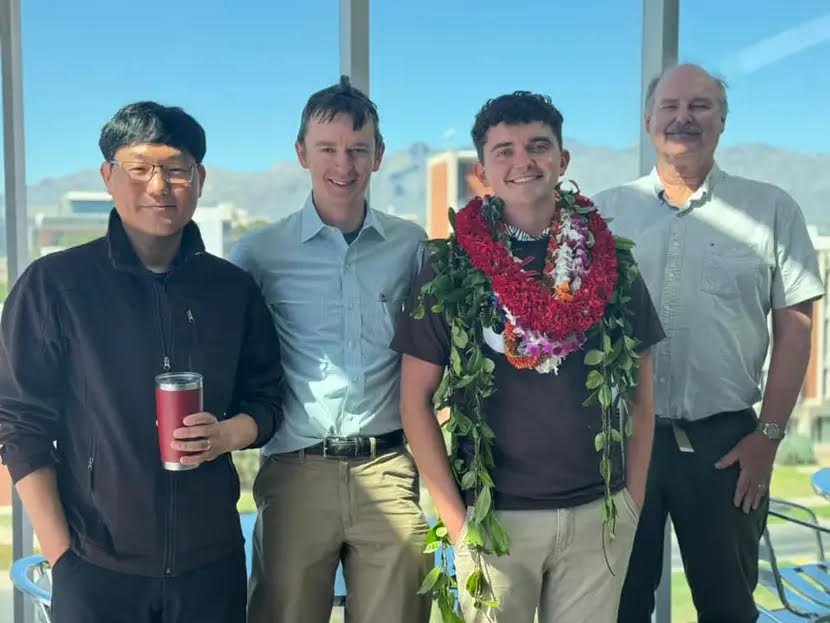
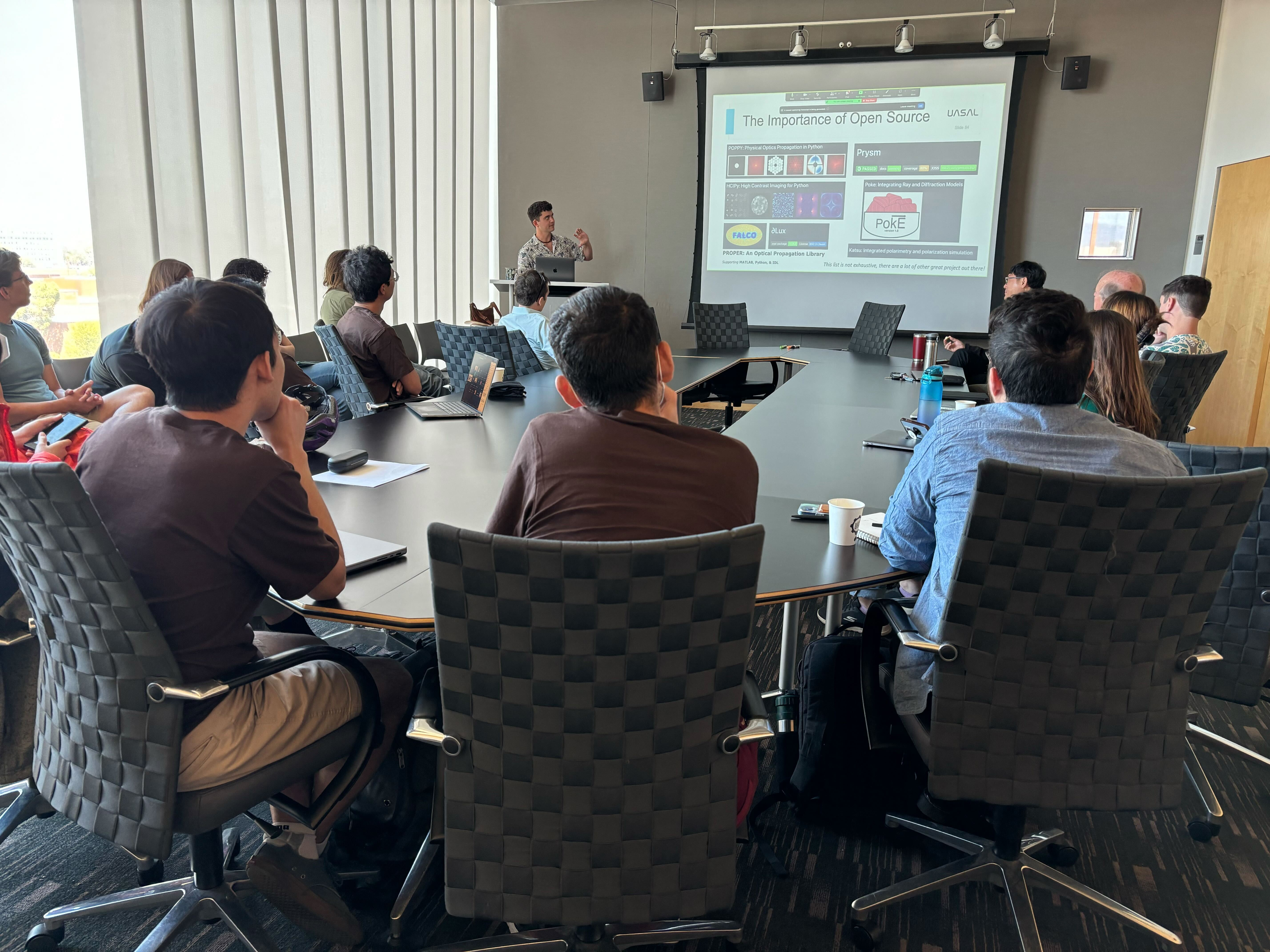
<p>Last week, on April 15th, Jaren Ashcraft successfully defended his thesis focused on the development of open-source physical optics modeling packages, use of Gaussian Beamlet Decomposition in optical modeling, and polarization ray tracing in optical system modeling. He absolutely nailed it, in my humble opinion, and the committee thought so too! We are all so proud of him and wish him the best of luck at UC Santa Barbara, where he will continue his optical modeling work in preparation for high contrast imaging onboard the Habitable Worlds Observatory, supervised by friend-of-UASAL Dr. Max Millar-Blanchaer!
<img src="/assets/jaren_defense.png" alt="jaren's defense" width="800" /></p>

<p><em>Jaren standing on his soap box, discussing the importance of open source. Photo credit: Chia-lin Ko</em></p>

<p><img src="/assets/jaren_committee.png" alt="jaren's committee" width="800" /></p>

<p><em>Jaren with his in-person thesis committee! Left to right: Prof. Daewook Kim, Prof. Ewan Douglas, Dr. Jaren Ashcraft, Prof. Lars Furenlid. Not pictured: Prof. Olivier Guyon</em></p>

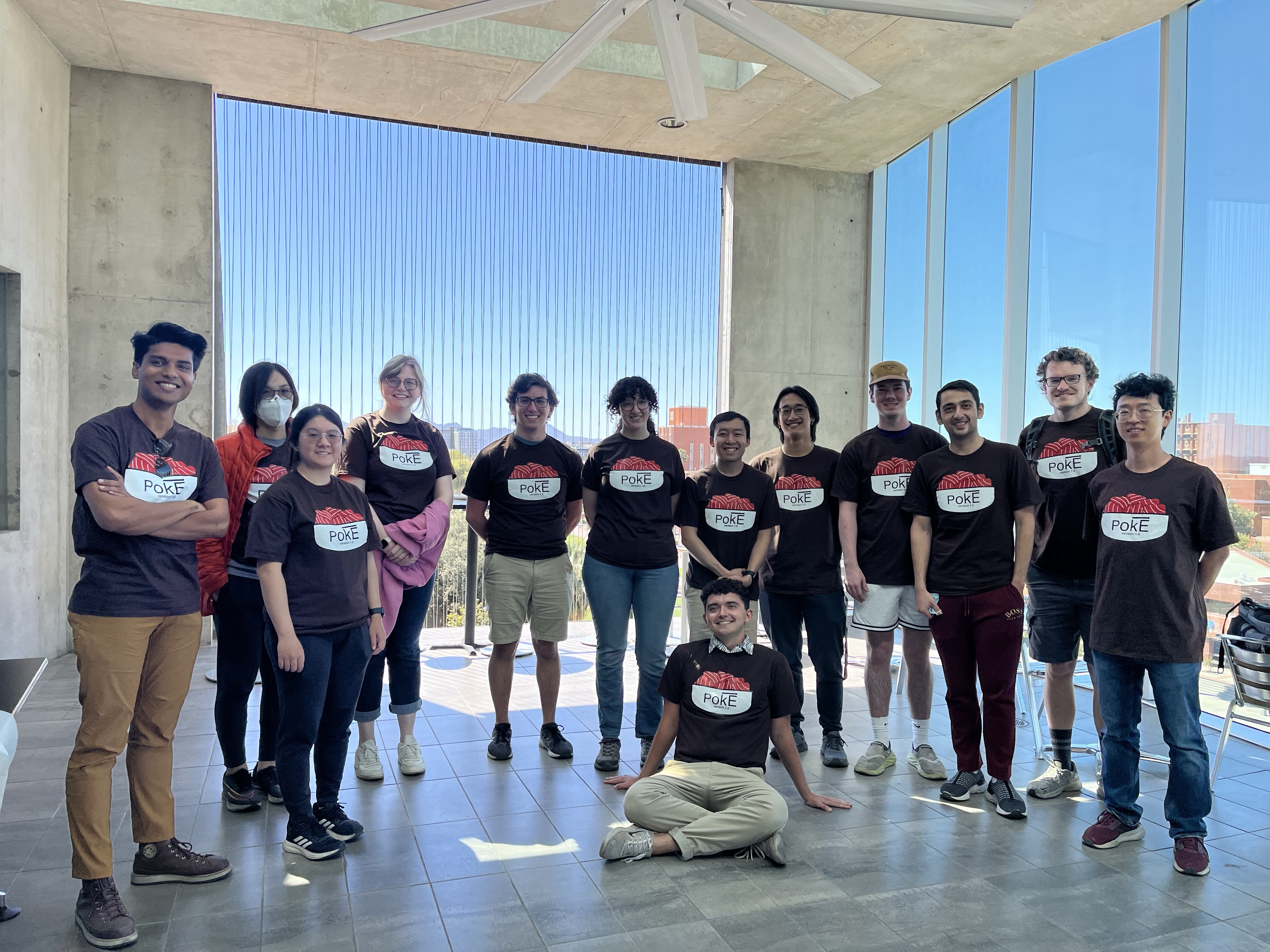
<p>While he’s still around for a few more weeks, we are all going to miss him dearly when he takes off. Even though I’ve only joined the group relatively recently, I could immediately tell how Jaren’s positive and welcoming attitude has fostered such a wonderful working environment within UASAL, and this is clearly evident in the efforts some of our group members undertook to make sure his defense was special! 
Postdoc Ramya and grad student Kian went through extra effort to obtain these awesome shirts with the logo of Jaren’s open-source package PokE for the entire group to wear at his defense!</p>

<p><img src="/assets/PoKE_shirts.jpg" alt="poke shirts" width="800" /></p>

<p><em>Photo credit: Ashcraft family</em></p>

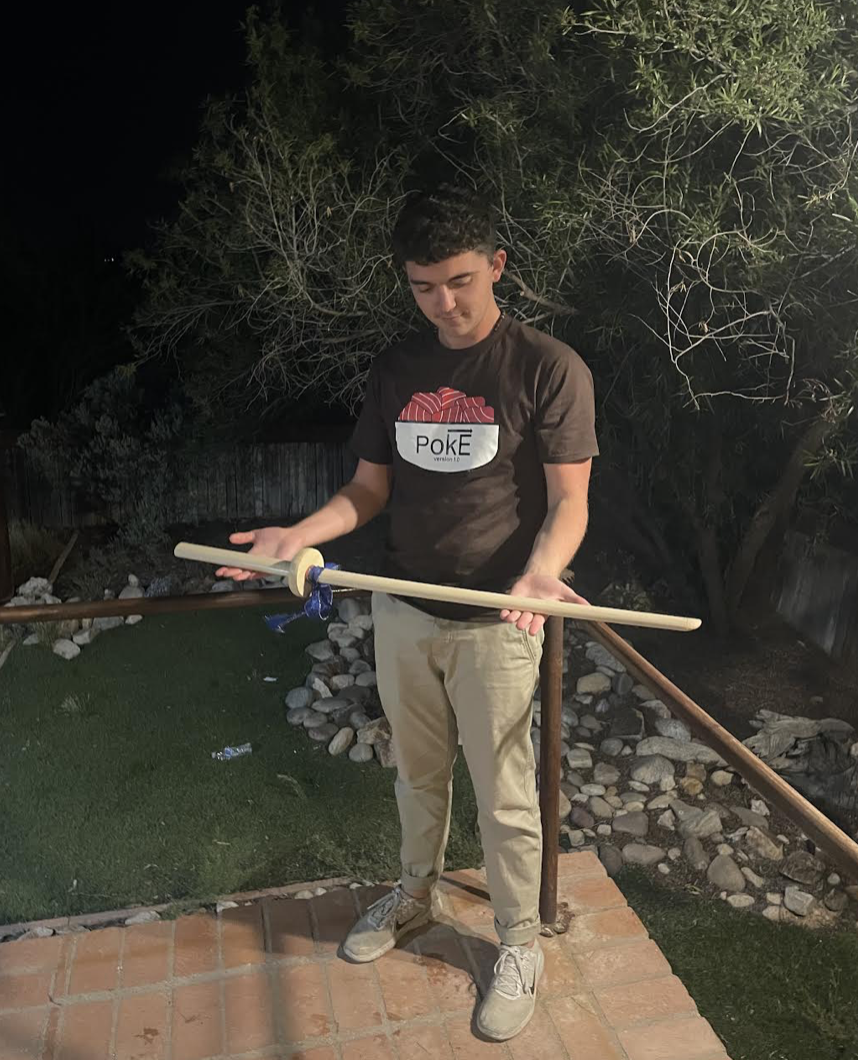
<p>Ewan also prepared a laser-etched wooden sword as a gift, intended for the so-called “snake-fight” a PhD student may undertake as part of their dissertation defense.</p>

<p><img src="/assets/jaren_sword.png" alt="jaren's sword" width="600" /></p>

<p><em>Yes, Ewan gave Jaren sword-fighting lessons too. Kian described the training effort as “wholesome.”</em></p>

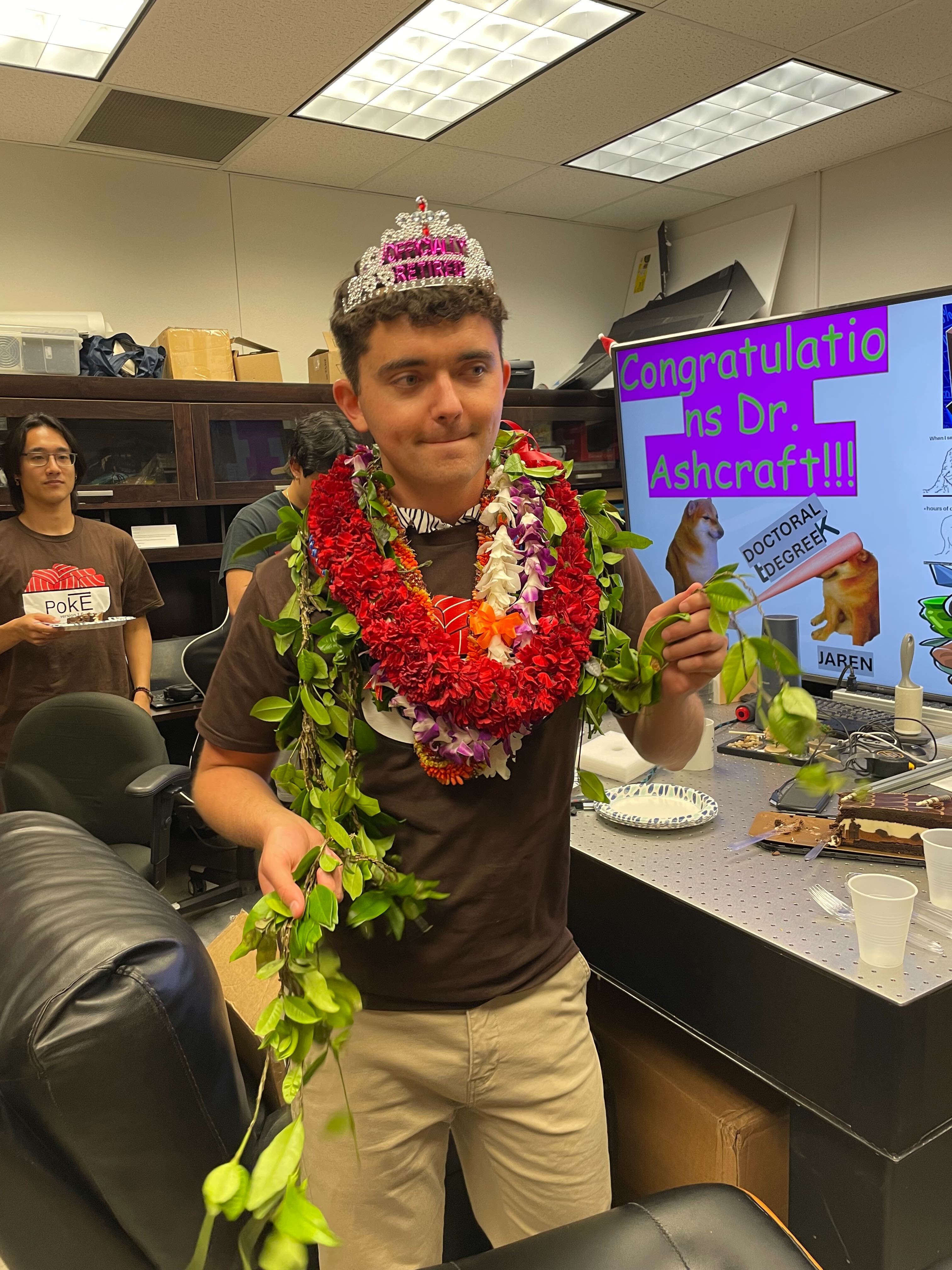
<p>At any rate, congratulations to the new Dr. Ashcraft once again!! We’re excited to see what the future brings you!</p>

<p><img src="/assets/jaren_party.jpg" alt="jaren's party" width="600" /></p>

<p><em>Dr. Ashcraft celebrating in the LOFT lab space. Photo credit: Maggie Kautz</em></p>

<p>P.S., if you’re interested in some of the awesome open-source software Jaren has developed, check out his <a href="https://github.com/Jashcraf">github!</a></p>

<p>P.P.S., we’re hoping to have more blog authors and more regular posts, so stay tuned!</p>]]></content><author><name>[&quot;Justin H&quot;]</name></author><category term="students" /><category term="team" /><category term="graduate students" /><category term="milestones" /><category term="blog" /><summary type="html"><![CDATA[Hey folks! This is Postdoc Justin, here to announce a recent milestone achieved by one of the members of our team!]]></summary></entry><entry><title type="html">Sensor Characterization Reports</title><link href="https://uasal.github.io/testing/sensor_reports/" rel="alternate" type="text/html" title="Sensor Characterization Reports" /><published>2024-04-02T00:00:00+00:00</published><updated>2024-04-02T00:00:00+00:00</updated><id>https://uasal.github.io/testing/sensor_reports</id><content type="html" xml:base="https://uasal.github.io/testing/sensor_reports/"><![CDATA[<p>In order to assess the suitability of CMOS sensors for astronomical applications we have been testing a range of commercially available sensors and camera packages with our colleagues in the <a href="https://itl.arizona.edu/">UA Imagining Technology Lab</a>, led by Dr Jarron Leisenring and founded by Dr. Michael Lesser.</p>

<p>Test results to date include:</p>

<ul>
  <li>
    <p><a href="/assets/reports//ZWO_ASI2600MM_combined_report.pdf">Sony IMX571 in ZWO ASI2600</a></p>
  </li>
  <li>Preliminary <a href="/assets/reports/CharacterizationReport__ASI292_1812911309020900.pdf.pdf">ZWO ASI294</a></li>
  <li><a href="/assets/reports/CharacterizationReport__ASI294_bin2_20c_2f348f01230009000.pdf">ZWO ASI294 in Bin 2 at 20C</a></li>
  <li><a href="/assets/reports/CharacterizationReport__ASI294_bin1_n15c_2f348f01230009000.pdf">ZWO ASI294 in Bin 1 at -15C</a></li>
</ul>]]></content><author><name>[&quot;Ewan&quot;]</name></author><category term="testing" /><category term="reports" /><category term="blog" /><summary type="html"><![CDATA[In order to assess the suitability of CMOS sensors for astronomical applications we have been testing a range of commercially available sensors and camera packages with our colleagues in the UA Imagining Technology Lab, led by Dr Jarron Leisenring and founded by Dr. Michael Lesser.]]></summary></entry><entry><title type="html">SPIE Optics+Photonics 2023 Conference Proceedings Wrap up</title><link href="https://uasal.github.io/conferences/SPIE_OP_2023/" rel="alternate" type="text/html" title="SPIE Optics+Photonics 2023 Conference Proceedings Wrap up" /><published>2023-10-14T00:00:00+00:00</published><updated>2023-10-14T00:00:00+00:00</updated><id>https://uasal.github.io/conferences/SPIE_OP_2023</id><content type="html" xml:base="https://uasal.github.io/conferences/SPIE_OP_2023/"><![CDATA[<p>Recently we published a series of conference proceedings from the SPIE Optics+Photonics meeting which explore potential approaches to lowering the cost of large space telescopes and coronagraphs:</p>
<ol>
  <li>The first, in <strong>Douglas, et al. (2023, September 1). Approaches to lowering the cost of large space telescopes. <a href="https://doi.org/10.48550/arXiv.2309.04934">arXiv.2309.04934</a></strong> we discussed how to translate lessons from ground-based observatories and NewSpace/CubeSat science into lower cost observatories and introduced a power-spectral-density parameterizations of wavefront evolution over time inspired by ground-based adaptive optics techniques. <a href="/assets/douglas_spie2023.pdf">slides</a></li>
  <li><strong>Kim, D. et al. (2023, September 1).Compact Three Mirror Anastigmat Space Telescope Design using 6.5m Monolithic Primary Mirror. <a href="https://doi.org/10.48550/arXiv.2309.04921">arXiv.2309.04921</a></strong>, introduced a telescope concept that uses a classic UArizona 6.5m borosilicate mirror and fits within a SpaceX Starship fairing without deployables,</li>
  <li><strong>Choi, H. et al. (2023).  Approaches to developing tolerance and error budget for active three mirror anastigmat space telescopes. <a href="https://arxiv.org/abs/2310.12376">arXiv.2310.12376</a></strong>  Summarized a notional tolerance budget to show that such a concept is capable of diffraction limited imaging.</li>
  <li>building on those two papers, Kang et al  described a lab experiment to begin validating the phase retrieval approaches introduced in Douglas et al: <strong>Kang, H., et al. (2023, September 1). Focus diverse phase retrieval testbed development of continuous wavefront sensing for space telescope applications. arXiv E-Prints. <a href="https://doi.org/10.48550/arXiv.2309.04680">arXiv.2309.04680</a></strong>,</li>
  <li>applying lessons from bending mode control of ground-based observatories to the parameter  <strong>Blomquist, et al. (2023, September 1). Analysis of active optics correction for a large honeycomb mirror. arXiv E-Prints. <a href="https://doi.org/10.48550/arXiv.2309.04584">arXiv.2309.04584</a>.</strong></li>
  <li><strong>Derby, K. Z., et al. (2023, September 1). Integrated modeling of wavefront sensing and control for space telescopes utilizing active and adaptive optics. arXiv E-Prints. <a href="https://doi.org/10.48550/arXiv.2309.05748">arXiv.2309.05748</a></strong></li>
</ol>

<p>In 2020 we introduced a simple of-axis coronagraph design: <strong>Maier, et al. (2020) <a href="http://arxiv.org/abs/2109.12718">arXiv.2109.12718</a></strong></p>

<p>Which was followed up in 2022 be the design and first-light papers for a vacuum coronagraph test bed based on on the same optical design: Ashcraft, et al (2022). <a href="https://doi.org/10.48550/arXiv.2208.01156">arXiv.2208.01156</a> and Van Gorkom, K., et al. (2022). <a href="https://doi.org/10.48550/arXiv.2208.01155">arXiv.2208.01155</a>.</p>

<p>At this year’s meeting we did a deep dive on a few areas of particular interest to the same coronagraph design, radiation-tolerant deformable mirror controllers:</p>
<ol>
  <li><strong>Haughwout, C., et al.  (2023). Compact deformable mirror driver electronics for risk tolerant astrophysics missions. In Astronomical Optics: Design, Manufacture, and Test of Space and Ground Systems IV (Vol. 12677, pp. 63–76). SPIE. <a href="https://doi.org/10.1117/12.2677714">10.1117/12.2677714</a>_</strong></li>
  <li><strong>Gorkom, K. V.,  et al. (2023). Optical characterization of a low-noise, high-resolution controller for MEMS deformable mirrors for space applications.  SPIE. <a href="https://doi.org/10.1117/12.2677878">10.1117/12.2677878</a></strong> (manuscript pending, presentation available with SPIE subscription). <a href="https://arizona.box.com/s/lcbire8wmao5ikm1at36y969u8v2o53p">Open Access Slides on UA Box</a></li>
  <li><strong>Mendillo, C. B., et al (2023). Reflective lyot stop low-order wavefront control for future large space telescope coronagraphs.  SPIE. <a href="https://doi.org/10.1117/12.2677654">10.1117/12.2677654</a></strong> (arXiv submission pending, available with SPIE subscription).</li>
</ol>

<p>And</p>
<ol>
  <li>model-free image-plane wavefront control algorithms to remove speckles with empirical calibration <strong>Milani, K.,(2023, September 8). Simulating the efficacy of the implicit-electric-field-conjugation algorithm for the Roman Coronagraph with noise. arXiv. <a href="https://doi.org/10.48550/arXiv.2309.04595">arXiv.2309.04595</a></strong></li>
  <li>We also assessed the limitations on coronagraph contrast due to polarization aberrations 
<strong>Anche, R. M., et al. (2023, September 1). Estimation of polarization aberrations and their effect on the coronagraphic performance for future space telescopes. arXiv E-Prints. <a href="https://doi.org/10.48550/arXiv.2309.04563">arXiv.2309.04563</a></strong></li>
  <li>and the quality of artificial stars (pinholes) used for coronagraph testing:<strong>Jenkins, E. L., et al. (2023, September 1). Microfabricated pinholes for high contrast imaging testbeds. arXiv E-Prints. <a href="https://doi.org/10.48550/arXiv.2309.04604">arXiv.2309.04604</a></strong></li>
</ol>]]></content><author><name>[&quot;Ewan Douglas et al.&quot;]</name></author><category term="conferences" /><category term="conferences" /><category term="papers" /><category term="blog" /><summary type="html"><![CDATA[Recently we published a series of conference proceedings from the SPIE Optics+Photonics meeting which explore potential approaches to lowering the cost of large space telescopes and coronagraphs: The first, in Douglas, et al. (2023, September 1). Approaches to lowering the cost of large space telescopes. arXiv.2309.04934 we discussed how to translate lessons from ground-based observatories and NewSpace/CubeSat science into lower cost observatories and introduced a power-spectral-density parameterizations of wavefront evolution over time inspired by ground-based adaptive optics techniques. slides Kim, D. et al. (2023, September 1).Compact Three Mirror Anastigmat Space Telescope Design using 6.5m Monolithic Primary Mirror. arXiv.2309.04921, introduced a telescope concept that uses a classic UArizona 6.5m borosilicate mirror and fits within a SpaceX Starship fairing without deployables, Choi, H. et al. (2023). Approaches to developing tolerance and error budget for active three mirror anastigmat space telescopes. arXiv.2310.12376 Summarized a notional tolerance budget to show that such a concept is capable of diffraction limited imaging. building on those two papers, Kang et al described a lab experiment to begin validating the phase retrieval approaches introduced in Douglas et al: Kang, H., et al. (2023, September 1). Focus diverse phase retrieval testbed development of continuous wavefront sensing for space telescope applications. arXiv E-Prints. arXiv.2309.04680, applying lessons from bending mode control of ground-based observatories to the parameter Blomquist, et al. (2023, September 1). Analysis of active optics correction for a large honeycomb mirror. arXiv E-Prints. arXiv.2309.04584. Derby, K. Z., et al. (2023, September 1). Integrated modeling of wavefront sensing and control for space telescopes utilizing active and adaptive optics. arXiv E-Prints. arXiv.2309.05748]]></summary></entry></feed>